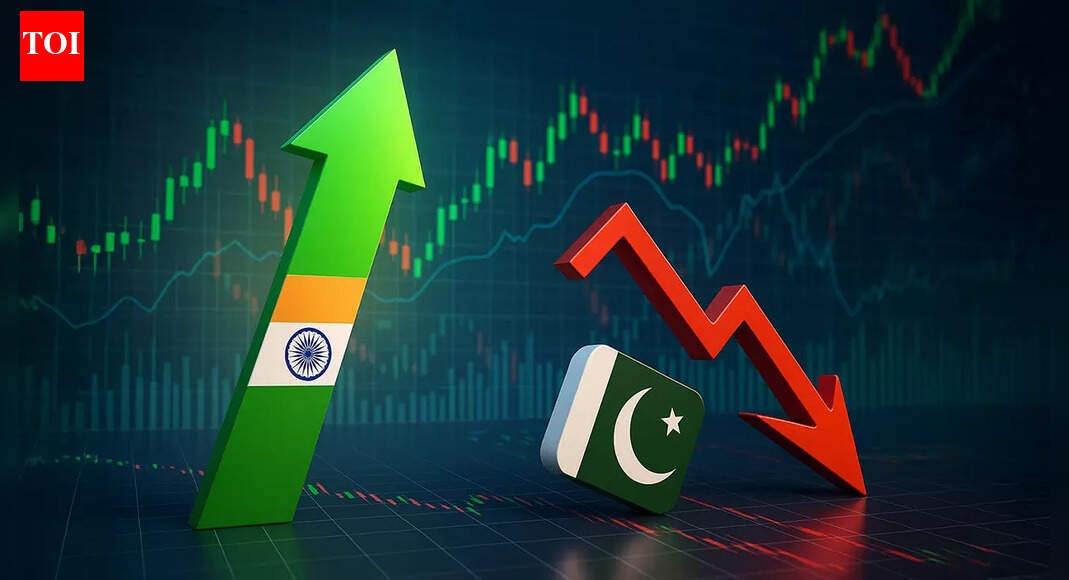
India's Economic Growth Dwarfs Pakistan's, Drawing Comparisons to Korea
Economist Noah Smith sparked discussion with his prediction that the economic divergence between India and Pakistan could lead to a future resembling "North and South Korea at night," highlighting the stark difference in their economic prosperity.
Diverging GDP Paths
Smith's analogy, shared on X, uses the image of a brightly lit South Korea contrasted with a dimly lit North Korea as a metaphor for the potential economic future of India and Pakistan. The core of the argument lies in the compounding effect of differing GDP growth rates.
Key Differences in Economic Performance
Here's a breakdown of the current economic landscape:
- India's Economy: Approximately $3.9 trillion in 2024.
- Pakistan's Economy: Roughly $370-410 billion in 2024.
- India's GDP per capita: About $2,700.
- Pakistan's GDP per capita: Roughly $1,500-1,700.
Growth Rate Disparity
India's economy is experiencing robust growth, while Pakistan's struggles to keep pace:
- India's Growth: Expanded by 8.2% in July-September, exceeding market forecasts and is on track for about 7% growth for the current fiscal year.
- Pakistan's Growth: Managed only 2.38% growth in 2024 after a contraction in 2023.
The Power of Compounding
While these differences may seem small annually, they compound over time. If India maintains a 6-7% growth rate while Pakistan remains at 2-3%, the economic gap will widen significantly. India's economy is already more than ten times the size of Pakistan's, with some Indian states having economies comparable to Pakistan's entire GDP.
Quality of Growth
The quality of growth also plays a crucial role. India has a diversified economy encompassing services, manufacturing, and a strong domestic market. The World Bank recognizes India as the fastest-growing major economy despite global challenges, supported by reforms and strong service sector performance.
Pakistan, however, faces recurring balance-of-payments crises and relies on IMF programs. Analyses point to "elite capture" and corruption as factors hindering growth.
Looking Ahead
If current trends continue, the predicted "before and after" image of the subcontinent in 2035 could show a significantly brighter India with developed infrastructure and industrial activity, while Pakistan's growth lags behind.